New EU Waste Framework Directive Guidance Outlines Food Donation Requirements from Around the World, Offers Best Practices for Policy Design
May 14, 2026
An estimated one-third of food produced globally is lost or wasted along the supply chain. In the European Union (EU), this amounts to about 59 million metric tons (~65 million pounds) of food wasted every year. One important solution to this issue is the recovery of surplus, edible food products for donation.
As countries around the world continue to take action to reduce food loss and waste, one emerging policy solution is to promote and support the donation of surplus, edible food. Food donation policies help to ensure that safe, edible, and nutritious surplus food is recovered and distributed to those who need it. Supporting food donation through legislation can be quite an impactful policy action because it solves multiple issues at the same time: these policies both decrease FLW (thereby curbing its negative economic and environmental impacts) and support food security.
In light of these benefits, many governments have begun to explore the adoption of food donation requirement policies. Going further than only supporting or incentivizing donations, a donation requirement mandates that certain generators of surplus, edible food ensure that this surplus is provided to food recovery organizations.
In October 2025, the European Parliament and the European Council amended the EU Waste Framework Directive (WFD) to add a provision mandating that EU Member States require select food businesses to propose food donation agreements with food recovery organizations. Member States must implement this provision by June 17, 2027.
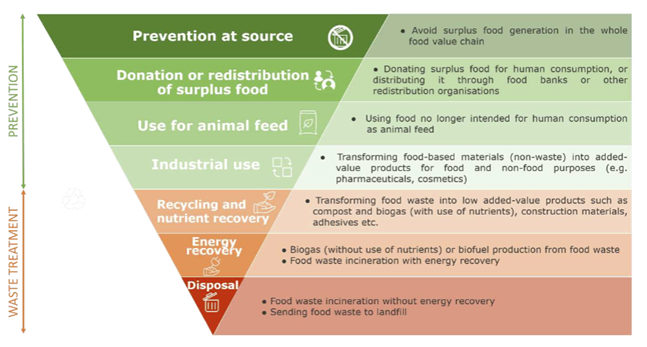
To support EU Member States in designing these policies, the Harvard Law School Food Law and Policy Clinic (FLPC) — in collaboration with the European Food Banks Federation (FEBA) and The Global FoodBanking Network (GFN) — has published a guidance document analyzing food donation requirement policies and outlining best practices for adopting food donation requirements. This project is part of our Global Food Donation Policy Atlas project, which analyzes, tracks, and compares policies on food waste and food donation in 30+ countries around the globe.
Our new WFD food donation requirement guidance includes:
A table that compares the different components of food donation requirements (such as covered entities and enforcement mechanisms) from 14 national and subnational jurisdictions around the world (pages 4–5);
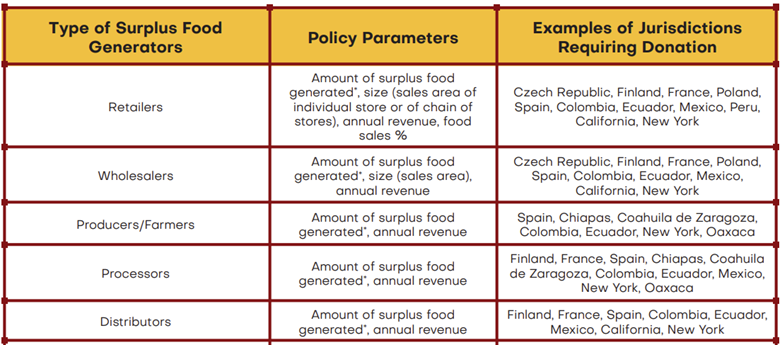
A table that lays out the types of surplus food generators that have been covered by each of these existing food donation policies (such as volume of surplus food generated, sales area, or annual revenue) (pages 6–7); and
Best practices for implementing food donation requirement policies that EU Member States and other policymakers can follow to ensure both that nourishing surplus food is donated to food recovery organizations and that these policies are equitably and feasibly designed (pages 12–20). These best practices are supported by examples from 30 different jurisdictions from across the globe.
The information in this guidance document can support both policymakers and advocates interested in adopting a food donation requirement policy. Also, while a food donation requirement can be an effective and impactful policy solution to reduce FLW, it is not the only type of donation policy that jurisdictions can adopt. To learn more about other policies that promote and support food donation, such as food safety requirements for donation, date labeling laws, liability protection for donated food, tax incentives, and government funding, visit the Global Food Donation Policy Atlas.